Map every AI tool across your hotels to each market’s rules in seconds, with clear next steps for every hotel team. Check your first AI tool for free.
Guest chatbots, passport scanners, pricing engines and camera analytics now run across your hotels. See what each one must meet in every market, and give owners and auditors the evidence that it does.

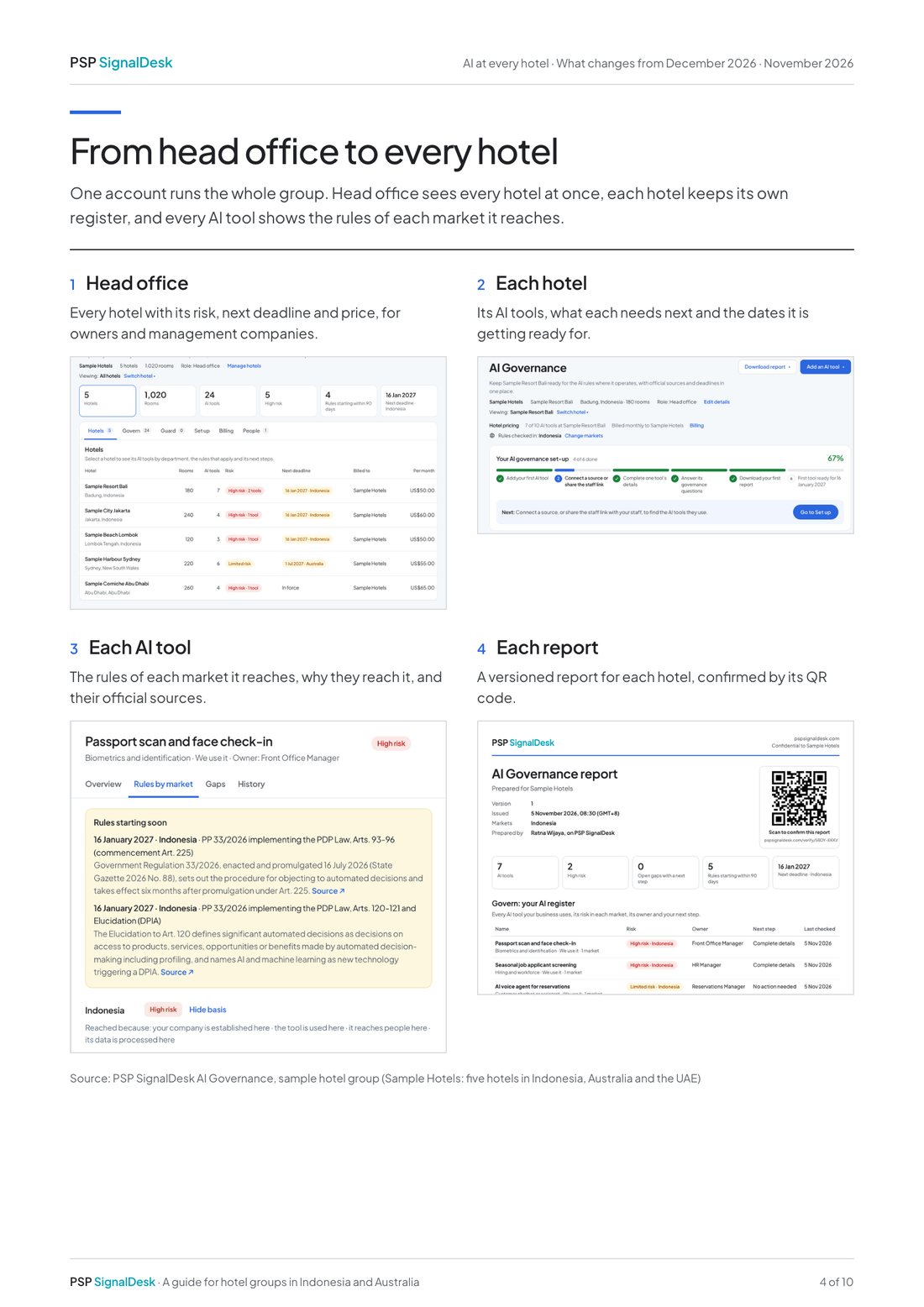
Add each hotel and its AI tools, see what each market requires, and share a report your owners can rely on.
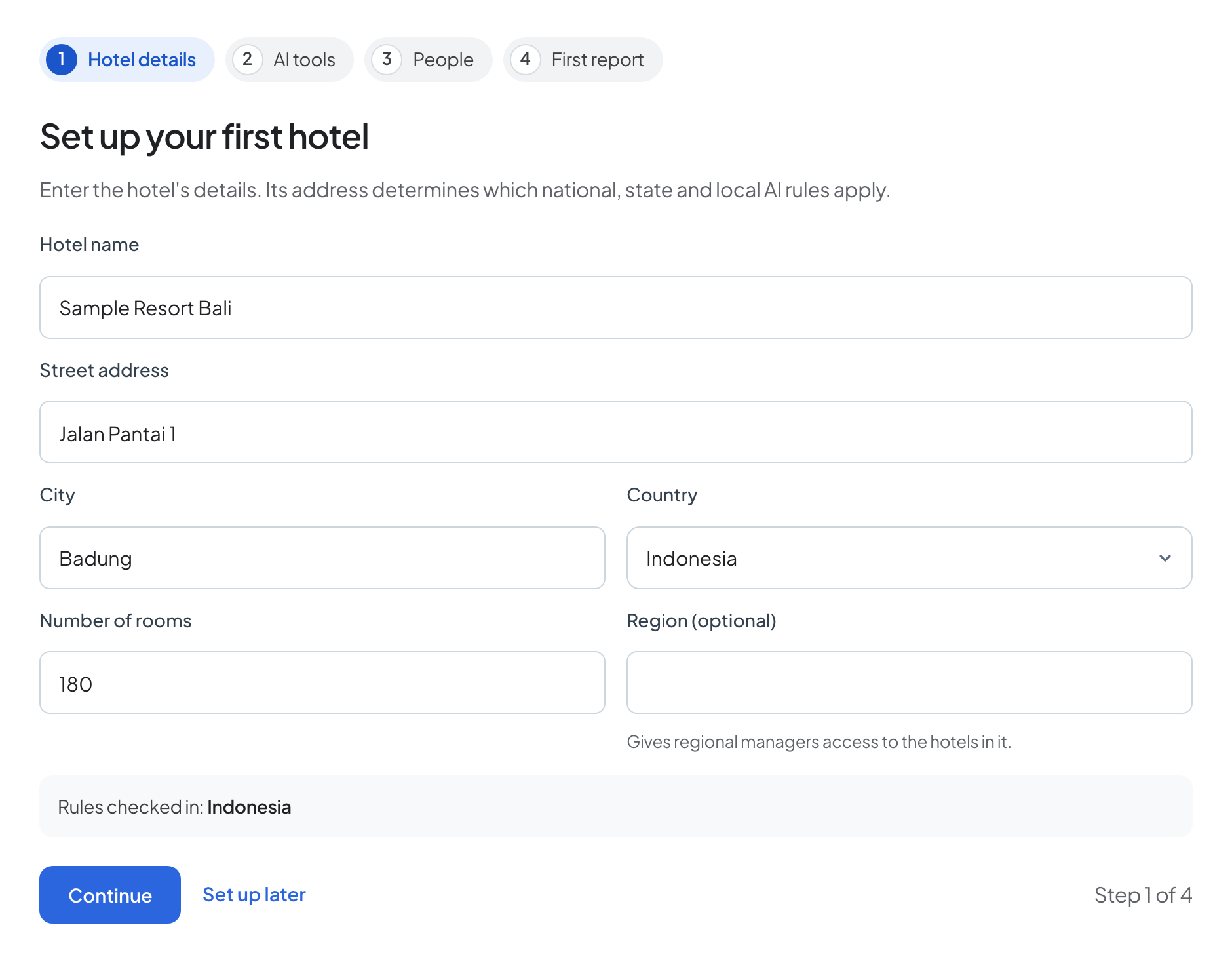
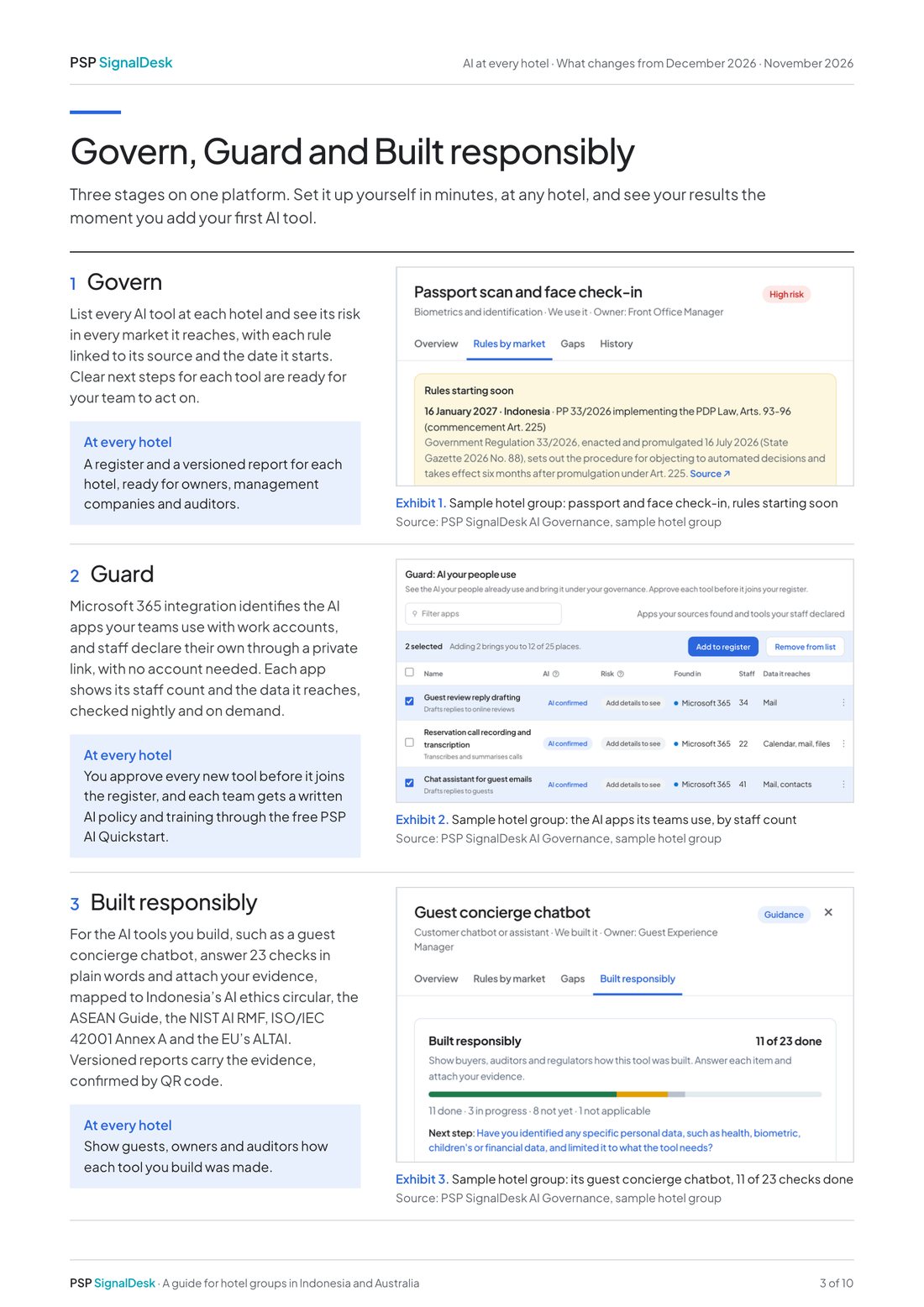
Its address sets the national, state and city rules it is checked against. Then add its AI tools: pick them from common tools, describe your own, or let Microsoft 365 and your staff link find them.

The rules for each hotel’s location, with each official source and the date new rules start.

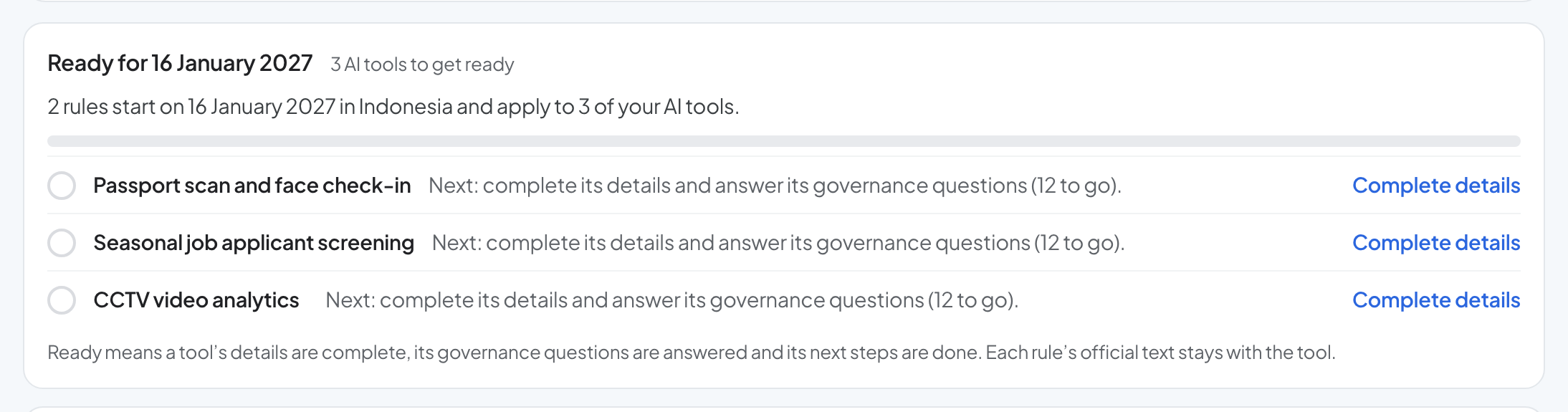
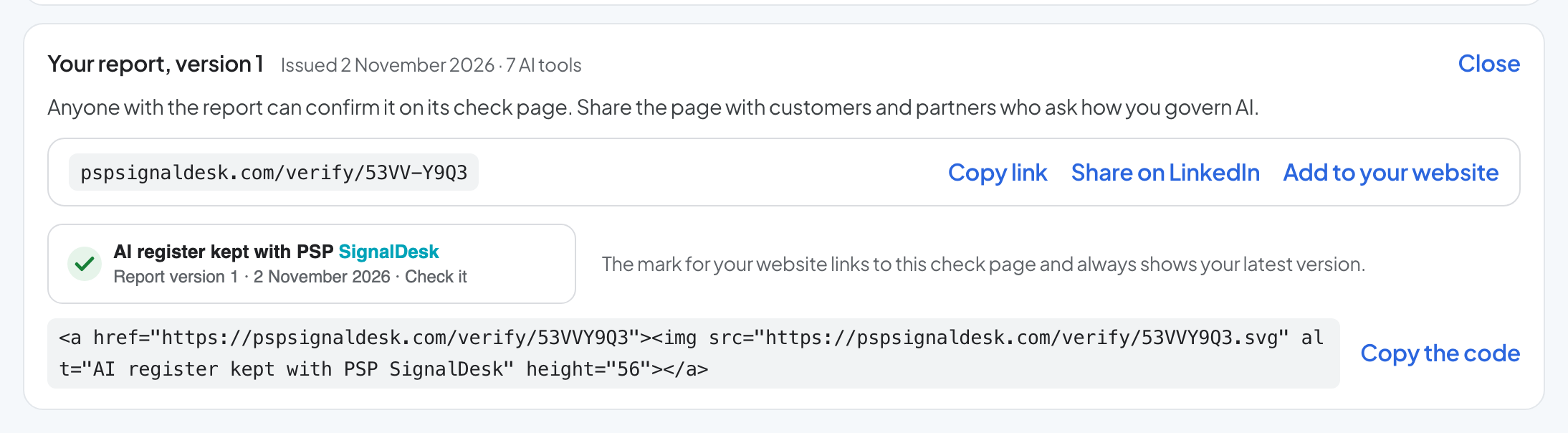
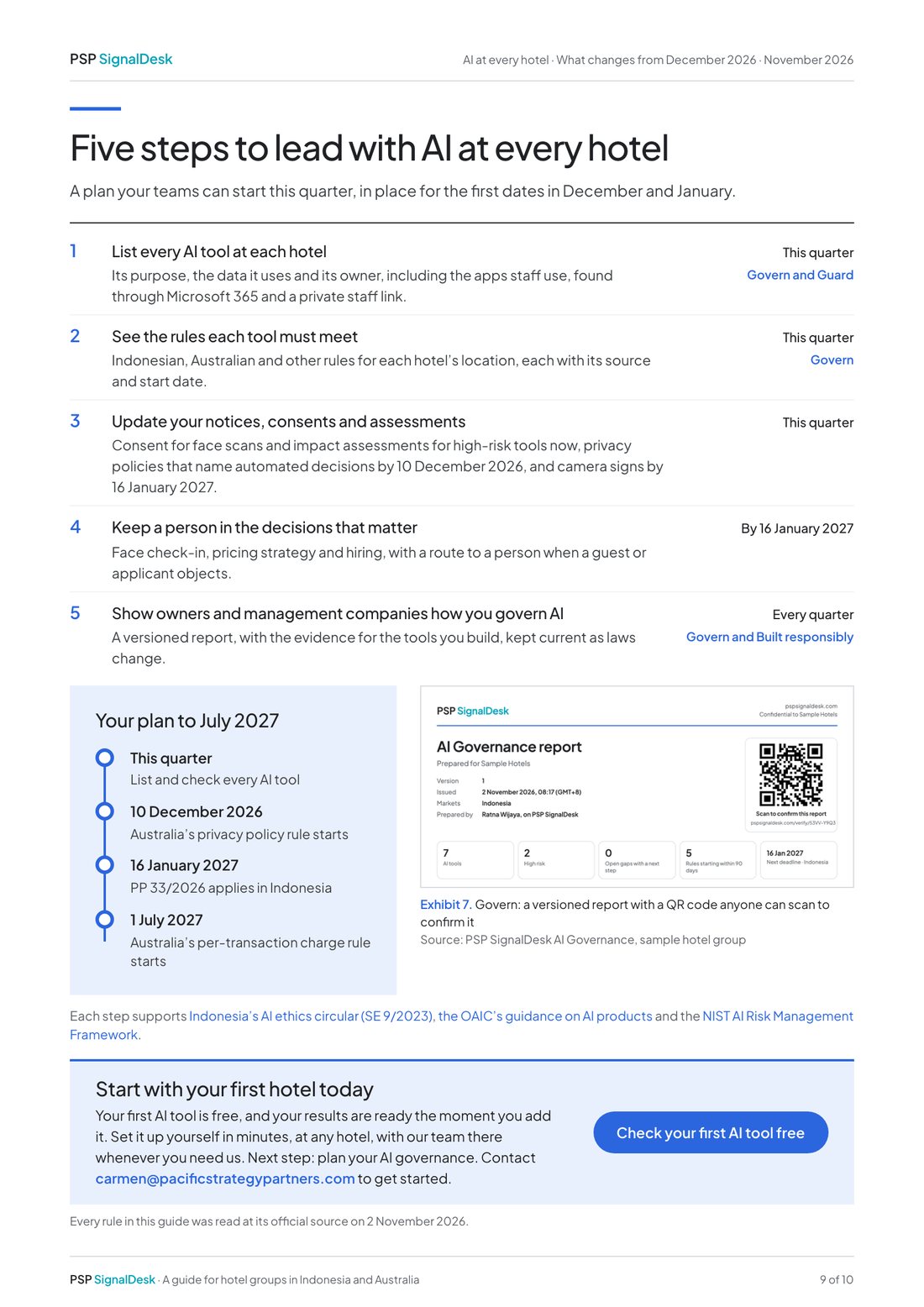
Follow your next steps and share a versioned report for each hotel with owners, management companies and auditors.

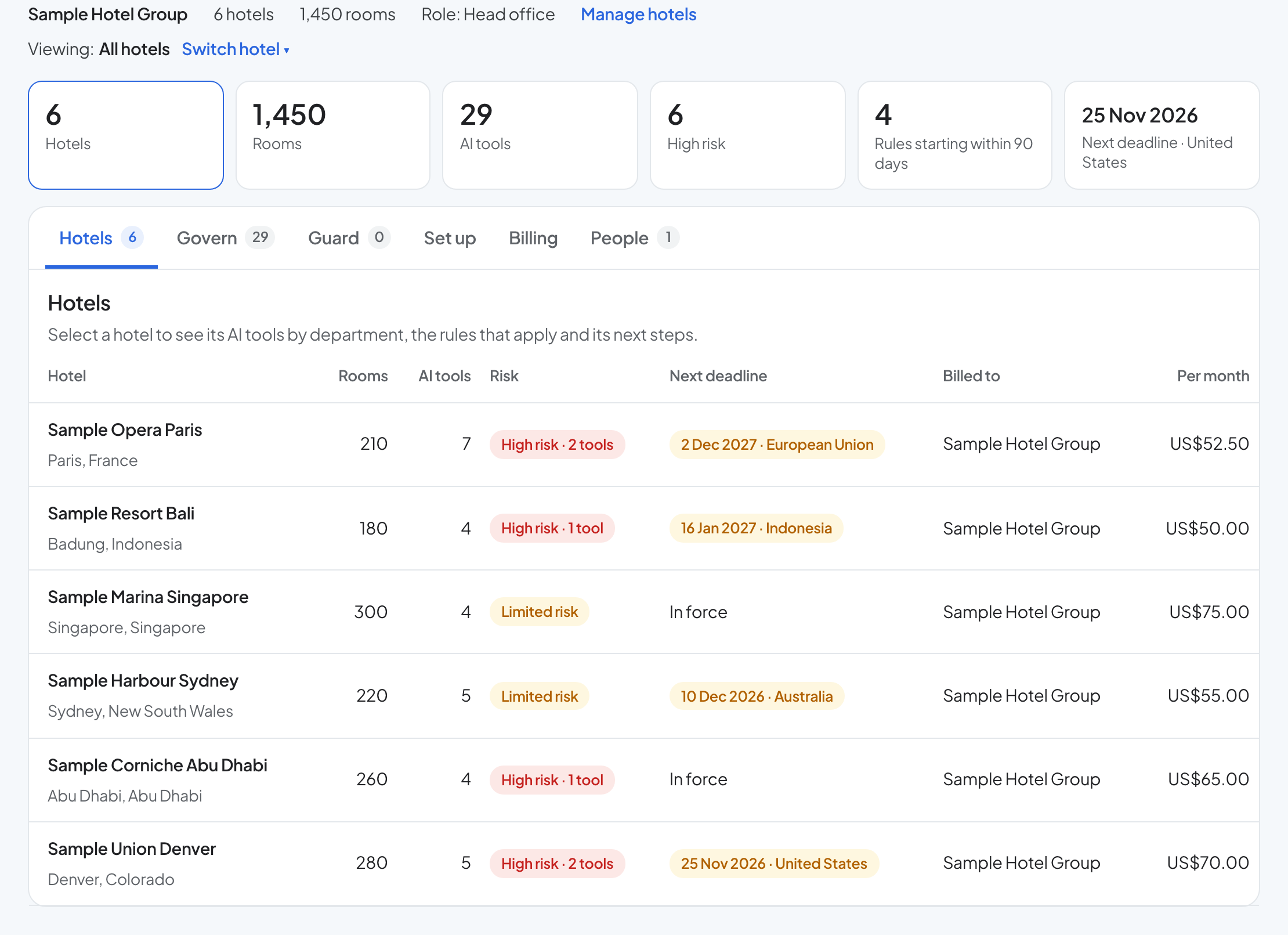
Each hotel is checked against the rules where it sits, and your head office sees every hotel, in every market, at once.
Your group-wide tools, from central reservations to revenue management, checked against the rules where your head office sits and in each market where your group does business.
Each hotel’s own national, state and city rules, from Bali to Denver, with an owner and next steps for every tool.
Every hotel’s risk, next deadline and report in one place, for owners, management companies and auditors.

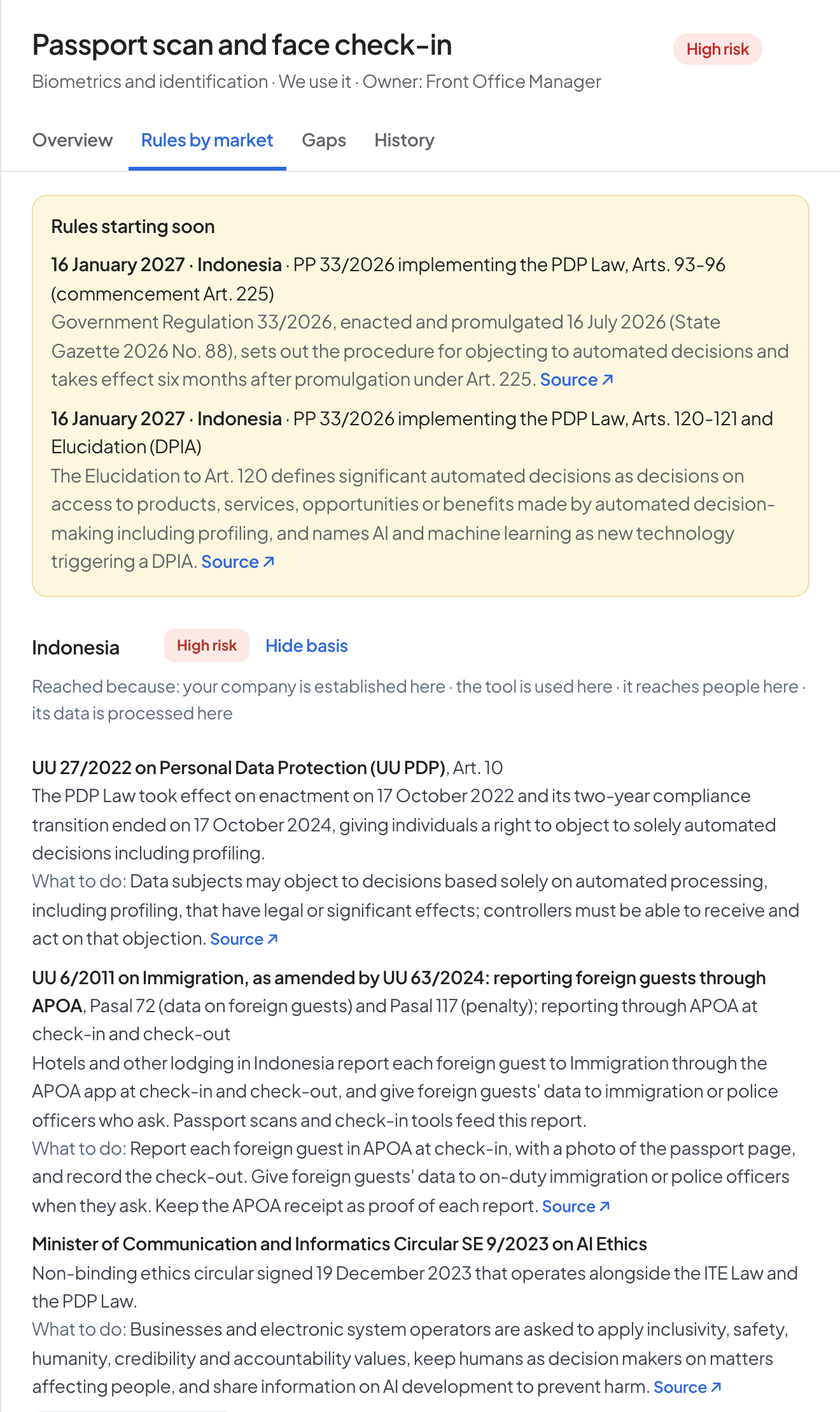
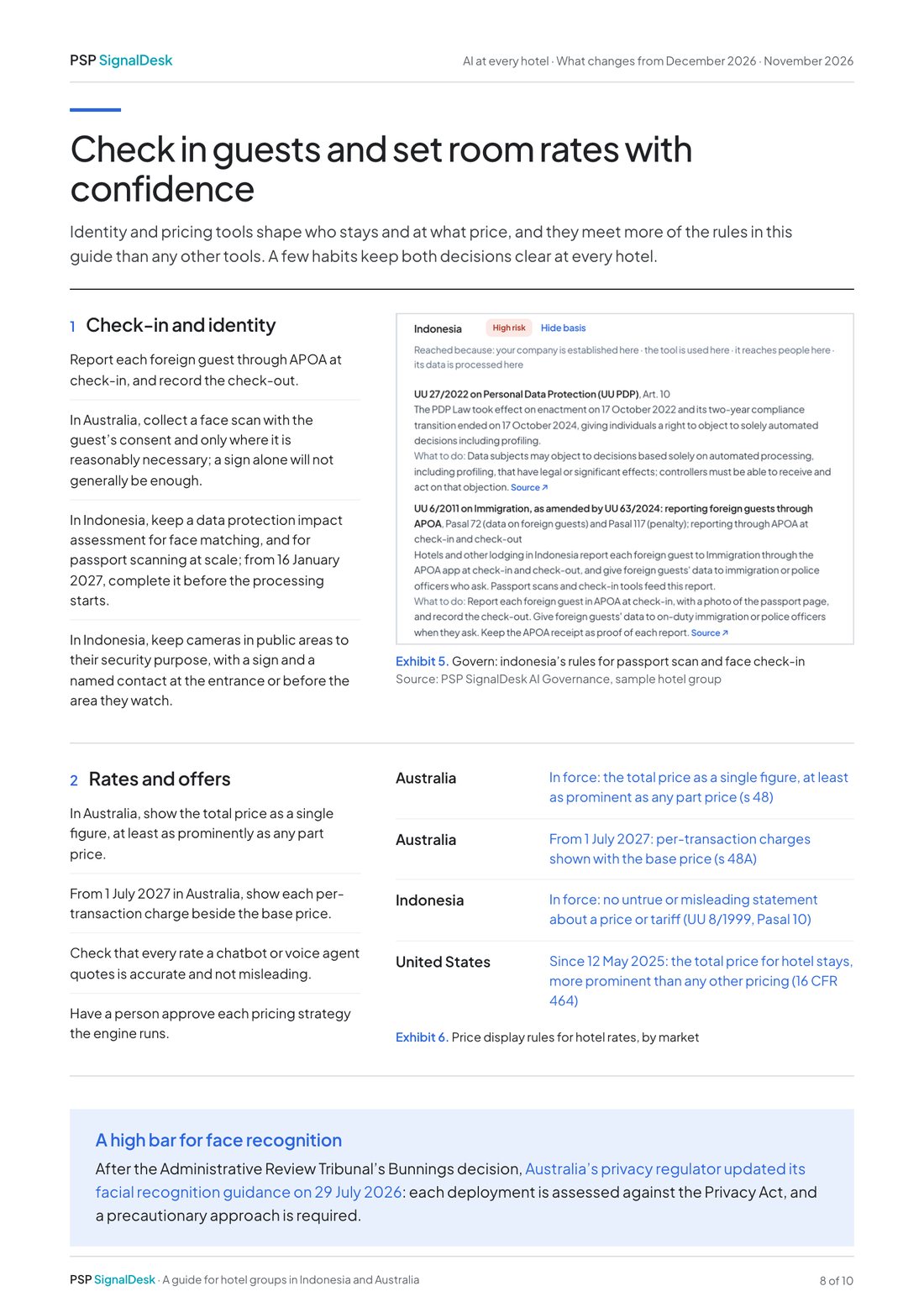
Add passport scan and face check-in at a hotel in Bali, and this is what you see.
Add passport scan and face check-in at a hotel in Sydney, and this is what you see.
Add passport scan and face check-in at a hotel in Abu Dhabi, and this is what you see.
Add passport scan and face check-in at a hotel in Paris, and this is what you see.
Add passport scan and face check-in at a hotel in Denver, and this is what you see.
See how each market’s rules class the tool, from minimal to high risk.
Each duty is linked to the official text and dated the day it was checked.
A short list your front office can act on today, kept current as laws change.
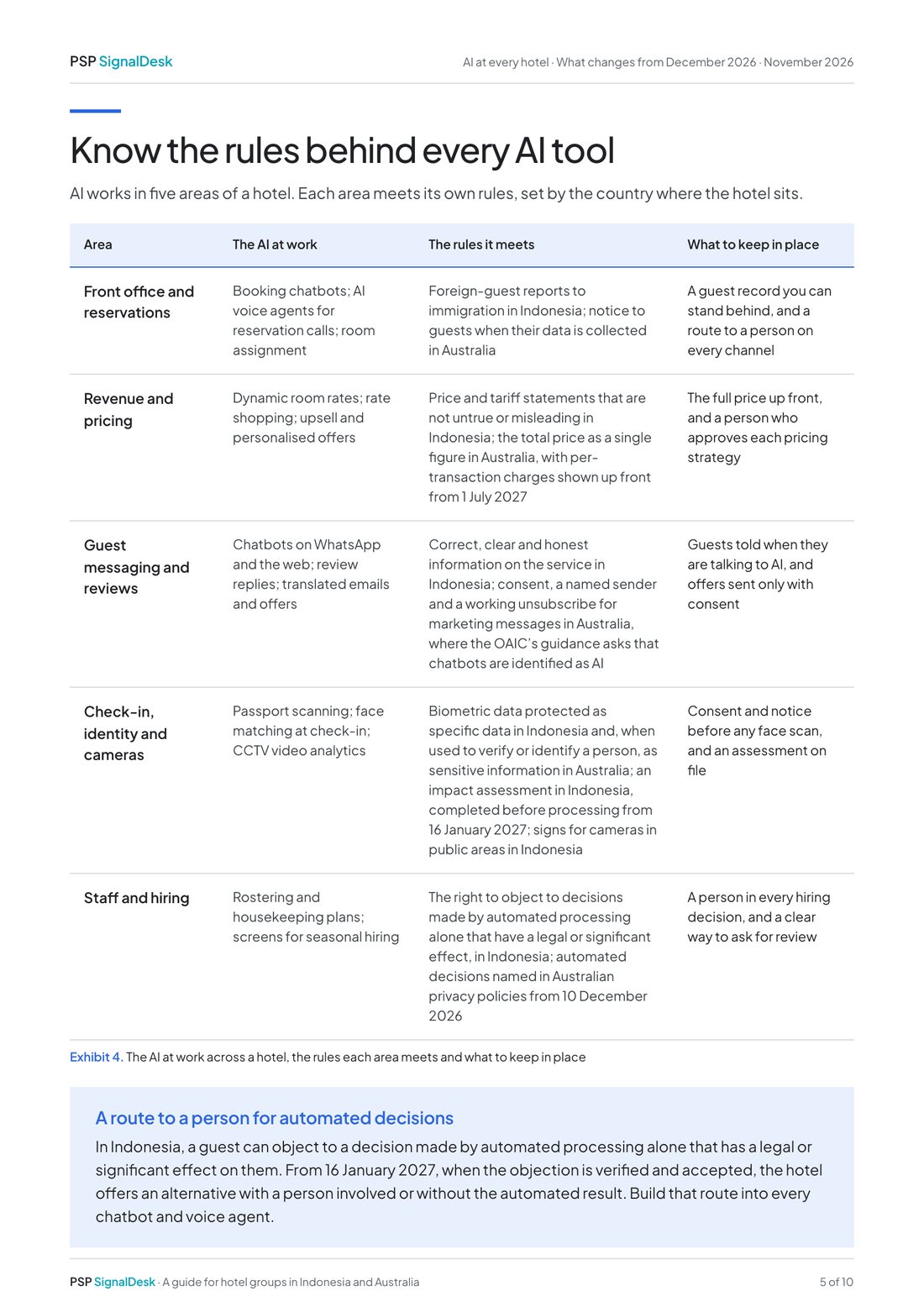
UU 6/2011 on Immigration and Immigration’s APOA notice: report each foreign guest in APOA at check-in, with a photo of the passport page, and record the check-out. UU 27/2022 on Personal Data Protection, Art. 10: guests may object to decisions made by automated processing alone, and the hotel must be able to receive and act on the objection.
Official source ↗ · Checked 2 November 2026PP 33/2026, Arts. 120 and 121: before high-risk processing starts, such as biometric data, new technology or automated decisions with a significant effect, complete and document a data protection impact assessment. Arts. 93 to 96: handle objections to automated decisions, explain the technology, and on an accepted objection offer an alternative with a person involved.
Official source ↗ · Checked 2 November 2026OAIC guide to facial recognition: assess the privacy risks before face check-in, collect face data only with valid consent, and offer guests who decline another way to check in. Privacy Act, Schedule 2: a person can sue for a serious invasion of privacy, without proof of damage.
Official source ↗ · Checked 2 November 2026Privacy Act, APP 1.7 to 1.9: significant automated decisions named in the privacy policy.
Official source ↗ · Checked 2 October 2026DCT Abu Dhabi Circular No. 6/2026: join Smart Check-In, with identity checks through ICP, run Pre Check-In, On-Site Verification and at least one more arrival journey, and keep guest data, face data included, for registration and verification only.
Official source ↗ · Checked 2 November 2026Federal Decree-Law No. 45 of 2021 (PDPL), Art. 18: guests may object to decisions from automated processing that have legal effects or seriously affect them.
Official source ↗ · Checked 1 November 2026GDPR, Art. 22: a decision about a guest made by automated processing alone, with a significant effect, rests on a contract, a law or explicit consent, with a person who can step in. EU AI Act, Art. 50: guests exposed to biometric categorisation or emotion recognition are told.
Official source ↗ · Checked 1 November 2026EU AI Act, Annex III: the high-risk duties for biometric systems apply from 2 December 2027, after Regulation (EU) 2026/1744 moved them from 2 August 2026.
Official source ↗ · Checked 1 November 2026HB 24-1130, the Colorado Privacy Act on biometric data: a public, written biometric policy with a retention schedule, and the required disclosures and consent before face data is collected.
Official source ↗ · Checked 29 October 2026NIST AI Risk Management Framework: the main US framework for mapping, measuring and managing AI risk. State privacy laws, which let residents of seventeen states opt out of profiling, apply once your business passes a law’s volume or revenue threshold, answered once in Set up.
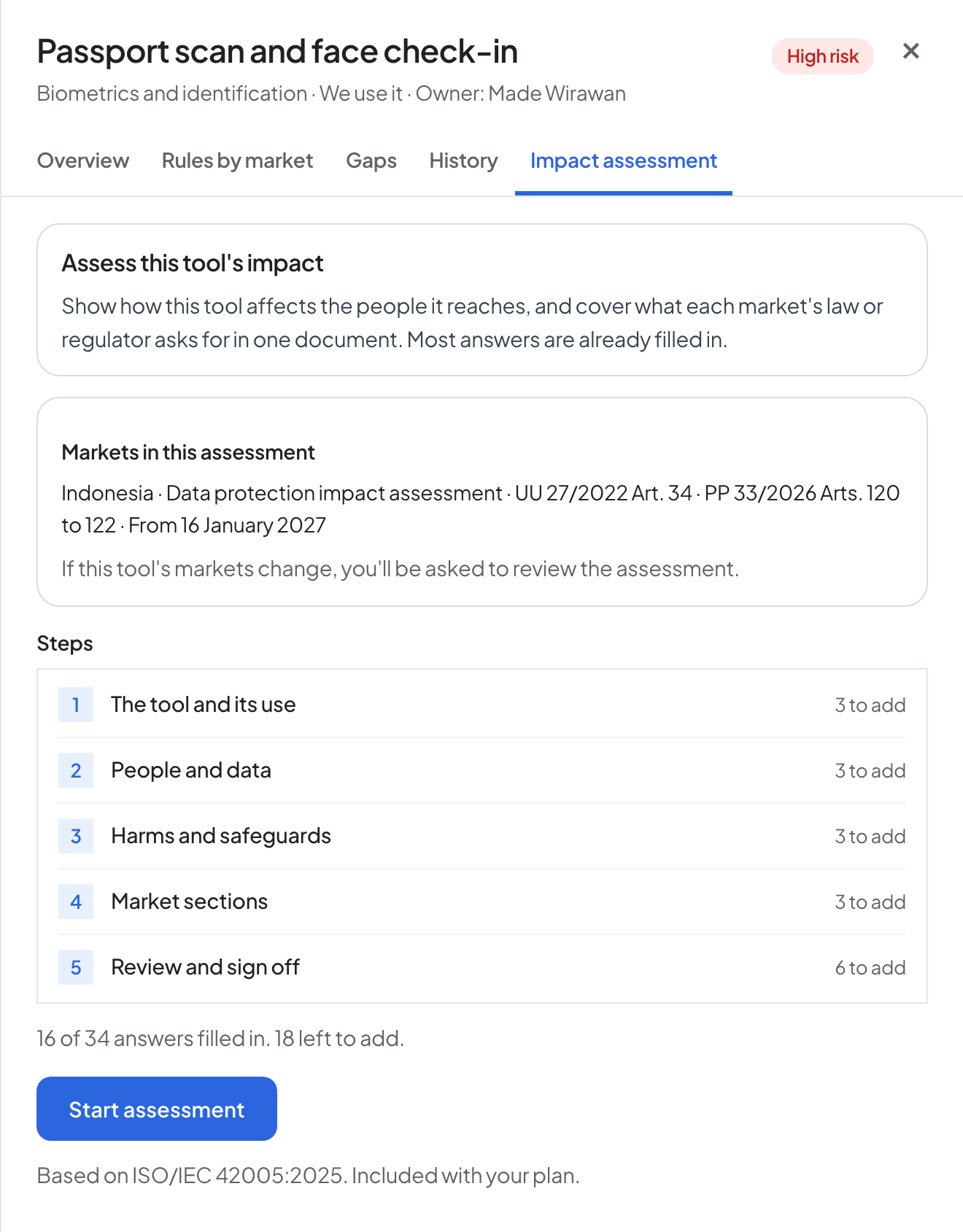
Official source ↗ · Checked 2 October 2026Its Impact assessment tab starts from the result above, fills most answers from your register and files a signed document you can show.

Free for AI Governance accounts that join before 16 January 2027. See the five steps
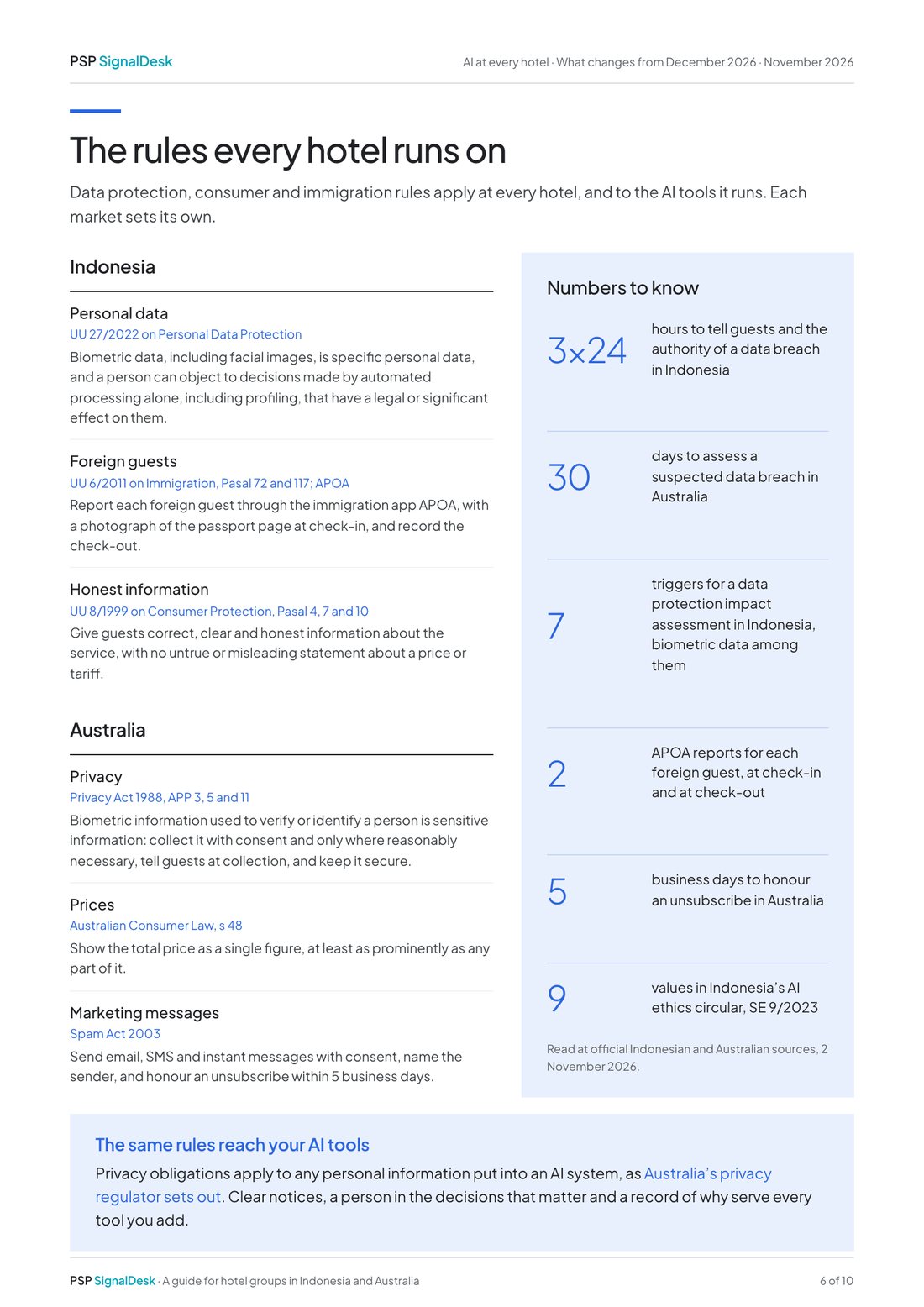
Data protection, consumer and immigration rules apply in every market. Choose a region to see three that shape AI at your hotels, each linked to its official source and kept up to date.

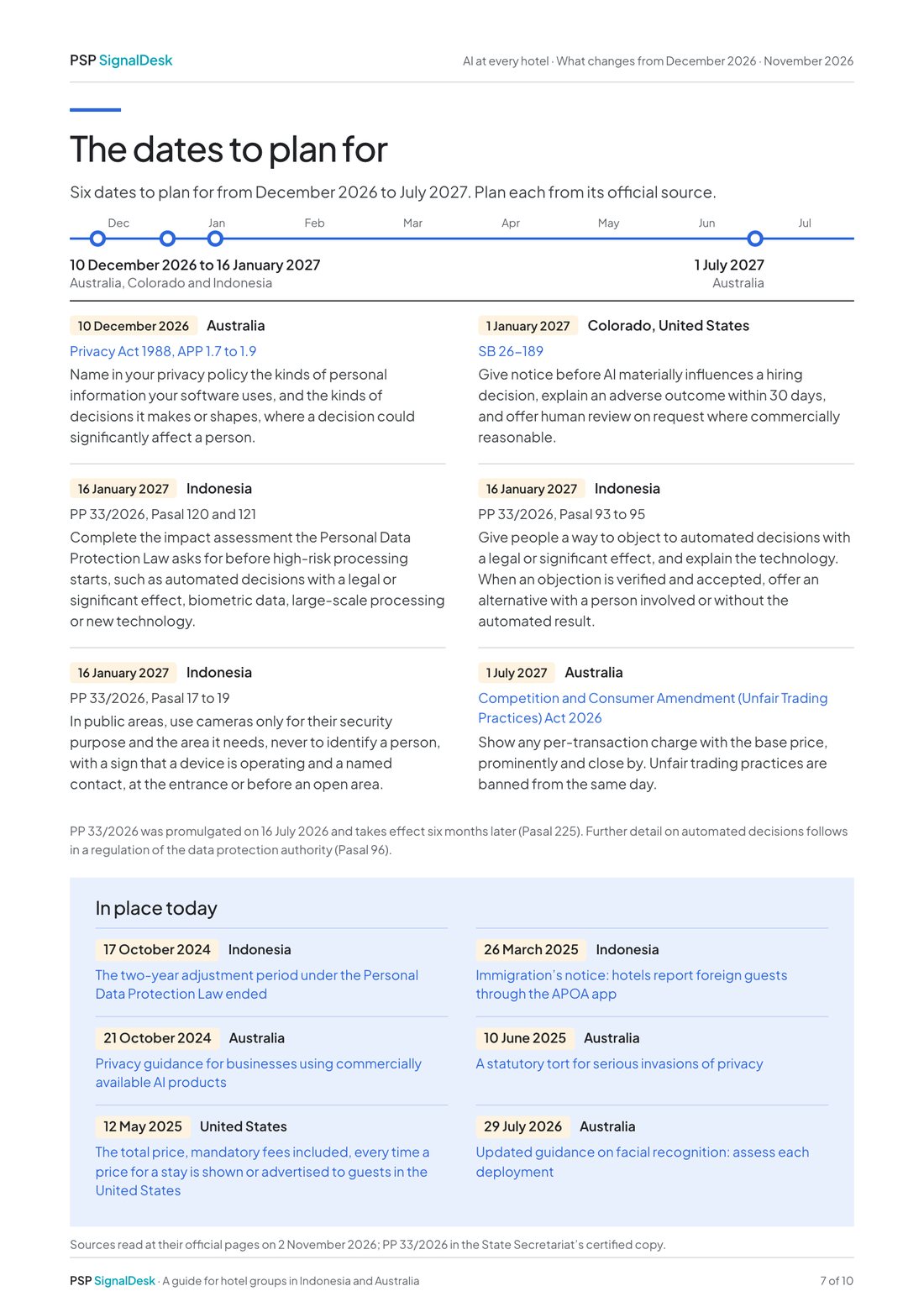
Ten pages for hotel groups in Indonesia and Australia: the rules each AI tool meets, the dates to plan for from December 2026 to July 2027, and five steps to lead with AI at every hotel.
Your free guide, ten pages. Keep it, share it with your teams, and start with your first AI tool when you are ready.


Each hotel gets its own register and report, priced by the rooms it runs.
Every AI tool at a hotel, kept current as laws change.
Pay monthly, or quarterly at 28% of the yearly price, or yearly for 10 months’ price.
Our AI governance practitioners, working alongside your front office, revenue and operations teams.
Check your first AI tool for free, with your results the moment you add it.
New to AI? Start with the free PSP AI Quickstart
Welcome back. Continue with Google, or sign in with your work email.
New here?
Free for one AI system. Upgrade at any time to a plan for 10, 25 or 50.
Already have an account?
A practice you may not use. No tool carries this label; where a ban could touch your tool, you see a check to run before you use it.
Laws in force set the heaviest duties for this use: an impact assessment, a person who reviews its decisions, notices to the people it affects, and records. Your next steps show what to do.
A law in force applies to this tool and carries penalties, without the heavier duties of high risk. Expect consent, transparency and data duties; your next steps show what to do.
No binding rule applies here today. Official guidance shows what regulators expect, so you can follow it now.
No binding rule reaches this tool in this market today. A rule that starts later shows here with its date.